
Grandparents
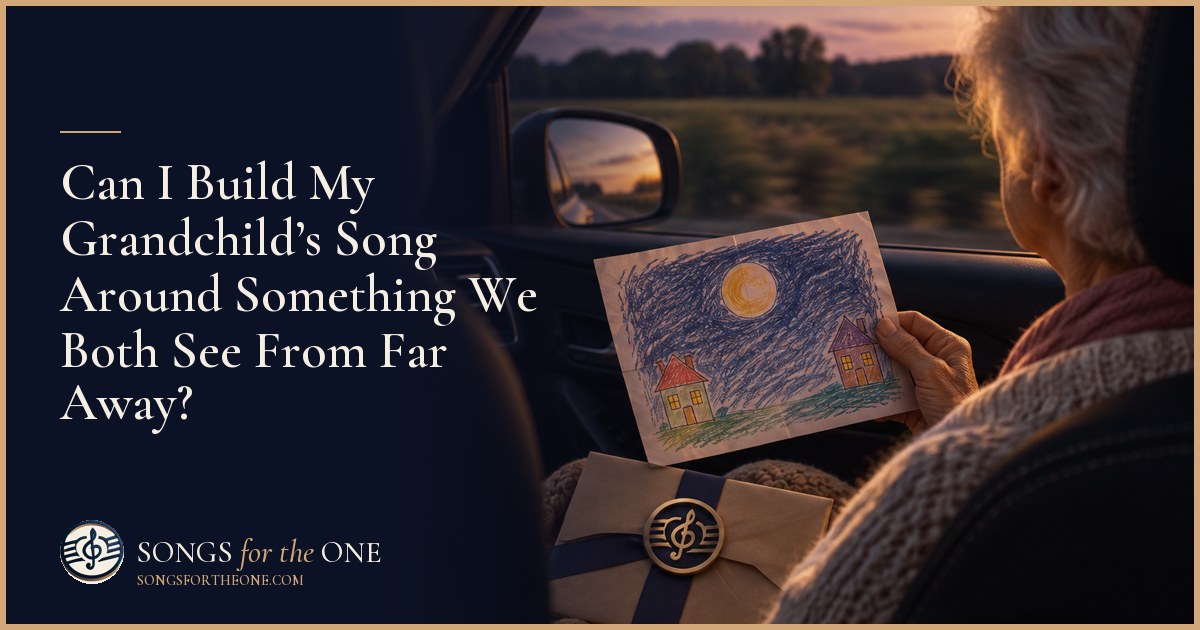
Can I Build My Grandchild’s Song Around Something We Both See From Far Away?
· 5 min read · By the Songs for the One team
The short answer
A long distance grandchild song can center on the moon, a season, or an everyday observation you share. The connection does not require matching weather or simultaneous views. Use one familiar image, acknowledge what differs between your homes, and give that image a clear message of love.
Key takeaways
- Choose one shared image your grandchild already recognizes.
- Describe each place honestly, including different weather or time zones.
- Connect the image to a real memory and one clear message.
- Offer a small shared ritual without making it an obligation.
- Check the story notes and hear a free preview before buying.
What can we share when we live far apart?
Yes, you can build your grandchild’s song around something you both notice from different places. The strongest choice is usually not the grandest symbol. It is something recognizable from your actual relationship: the moon you have talked about, birds outside your windows, or the first signs of a season. That recurring image gives the song a familiar place to return to.
You do not have to claim you are seeing exactly the same thing. You might share the moon, but see it at different hours or through different weather. You might both notice trees, but one view holds palms and the other bare branches. The song can connect those observations without flattening two distinct homes into one imaginary landscape.
Start with a practical question: what could your grandchild notice without needing a special outing or purchase? For example, if they enjoy telling you about puddles on their walk, rain might mean more than stars. If the night sky is unfamiliar or difficult to see from their home, choose something closer to their everyday life.
How do I choose a shared image that feels like us?
Look for three qualities: your grandchild recognizes it, it connects to you somehow, and you can describe it simply. A shared moon works especially well when there is already a memory attached. For example, you may have pointed it out together during a visit. Without that connection, another observation may make the song feel more personal.
Try completing this sentence before you choose: “When I notice this, I remember us doing or saying something together.” The answer does not need to be dramatic. It could be watching a bird hop along a fence or arguing cheerfully about whether a cloud looked like a rabbit. One small, true detail carries more meaning than a collection of beautiful but unrelated images.
Choose one main motif rather than filling the song with moons, oceans, rainbows, and flowers. Supporting details can come from both homes, but one returning image makes the connection easier to follow. For a younger grandchild, choose something concrete. For an older grandchild, consider an observation tied to an interest they genuinely have, rather than one they have outgrown.
What if our weather, seasons, or time zones are different?
Let the differences become part of the song. A truthful contrast often makes the distance feel understood rather than ignored. For example, you might describe frost on your window while your grandchild heads outside in sandals. The emotional connection is that you are thinking of each other, not that your surroundings have somehow become identical.
Be especially careful with promises about the sky. The moon is not always visible from both locations at the same time, and clouds or buildings may hide it. Instead of asking the song to say you are both looking at it right now, ask for the idea that noticing the moon reminds each of you of the other, whenever it appears.
Seasons can work in the same way. If you live in different hemispheres, the song can hold your autumn alongside their spring. If one home has little seasonal change, use familiar local details rather than borrowed snow or falling leaves. Give each place one accurate observation. That makes both homes belong in the song, including the home where your grandchild is building their own life.
How does an everyday observation become a personal song?
An image becomes a song motif when it carries a message and returns at meaningful moments. Decide what you want your grandchild to hear beneath the description. Perhaps it is “I enjoy hearing about your world,” or “You are loved even when we cannot visit.” Keep that message clear enough that the scenery never has to do all the emotional work.
Next, gather a small set of ingredients: the shared image, one real memory, one detail from each home, and the feeling you want the music to leave behind. For example, a hypothetical grandparent might choose the moon, a memory of sitting together on porch steps, a city window, a country garden, and a calm, reassuring mood. These are story notes, not finished lyrics.
Keep the emotional weight appropriate for your grandchild. You can say you miss them without making them responsible for your loneliness. Ask for warmth rather than guilt, and avoid a message that implies they should call every time they see the chosen image. The motif should feel like a welcome reminder of your relationship, not a test of how often they think about you.
What should I tell Muse about our shared view?
Songs for the One makes original, personalized songs with AI assistance. You choose an occasion, then talk or type with Muse, a guide, for about 3 to 7 minutes. You do not need songwriting or music skills. The how it works page explains the process, which includes story notes showing what Muse understood.
Muse gathers five Song DNA elements: The One, The Moment, The Feeling, The Sound, and The Message. For this kind of song, those become your grandchild, the memory behind your shared observation, the emotional tone, a musical style, and what you most want them to hear. Explain the geographic differences too, especially anything the song must not accidentally describe as shared.
For example, a hypothetical prompt could be: “This is for my grandson. We watched the moon from my garden during his visit. He lives in an apartment now, and we have different bedtimes. I want a gentle acoustic sound and a message that I love hearing about his day.” Check the story notes for those distinctions. The song uses AI vocals, not your voice.
How can I share the song without creating another obligation?
Offer the song as something your grandchild can enjoy in their own way. For example, you could introduce it by saying, “Our moon conversation gave me an idea for a song for you.” If you suggest a ritual, keep it optional: sharing an occasional sky drawing, describing the weather during a call, or simply listening together when you next visit.
The core song is made in minutes, though processing time varies. The Song package costs $79 and includes the full song, an MP3 download, a gift page shared by link, a lyrics sheet, and five re-records. You can compare options on the pricing page. Anyone with the gift link can open it, so choose personal details with that sharing access in mind.
Before buying, listen for whether the song sounds like your relationship, not merely a song about the sky. Does it honor both homes? Is the central message easy to hear? Start with one honest observation and one thing you want your grandchild to know. You can create your grandchild’s song and hear a free preview before deciding whether to buy the full song.
Frequently asked questions
- Can we use the moon if my grandchild cannot always see it?
- Yes. Make the moon a reminder rather than a promise that you can both see it at once. The song can acknowledge cloudy nights or different viewing times.
- What if we have never talked about a shared observation?
- You can start with a simple conversation about what each of you notices outside. Tell Muse this is a new connection you want to create, rather than describing an invented shared memory.
- Is a song about the moon too young for a teenage grandchild?
- Not necessarily. Use language, memories, and a musical style that suit who your grandchild is now, and avoid turning the idea into a nursery rhyme unless that is what they would enjoy.
- Do I need to write a chorus or provide lyrics?
- No. You can tell Muse about your grandchild, your shared observation, a memory, and your intended message in ordinary language. No songwriting or music skills are needed.
- Can I hear the whole song for free before paying?
- You can hear a free preview before buying. The full song is paid, with The Song package priced at $79.
Plan your song
Further reading
- Great questions to ask the people you loveStoryCorps
- Friends and family advice for grandparentsAARP
- The science of gratitudeGreater Good Science Center, UC Berkeley