
Grandparents
How to Label Your Grandchild’s Keepsakes So Their Stories Stay With Them
· 5 min read · By the Songs for the One team
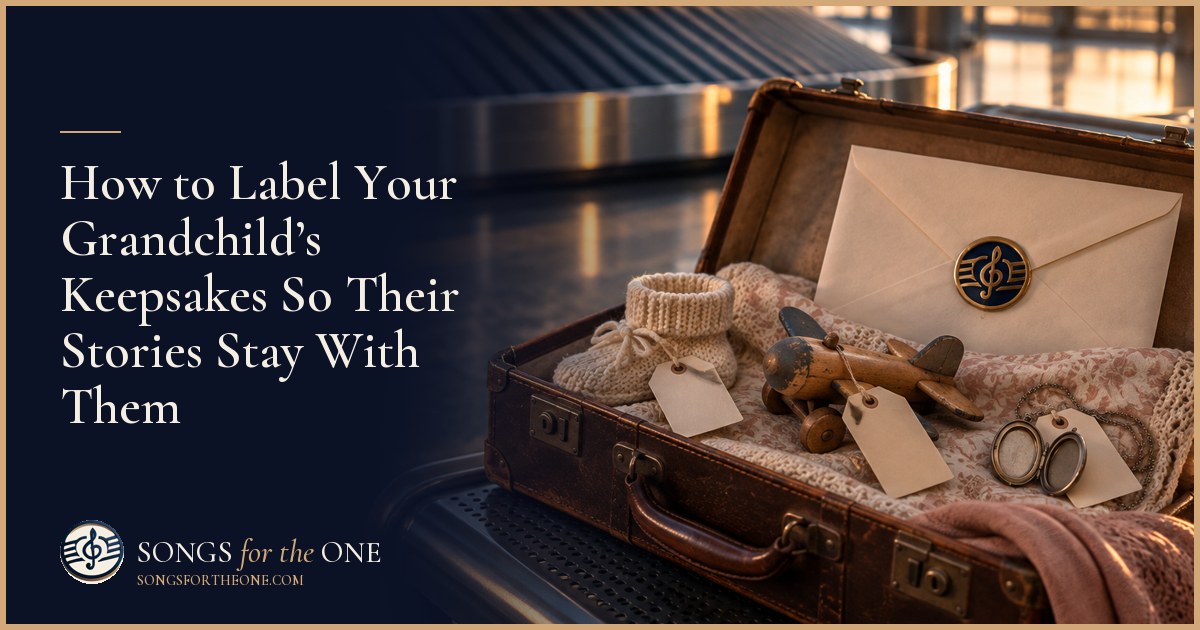
The short answer
Labeling family keepsakes means recording who made or owned each item, when and where it was used, and why it matters to your family. Keep a short identification card with the object and a longer story separately. Mark uncertain details clearly, and photograph each item with its matching record.
Key takeaways
- Record full names, relationships, dates, and the reason you saved each item.
- Use a short keepsake card plus a separate page for longer stories.
- Label the protective enclosure rather than attaching adhesive to fragile objects.
- Match objects, photographs, and story files with one simple item number.
- Leave room for your grandchild to decide what the keepsake means to them.
What should I write on a keepsake label?
Write the information your grandchild would need if you were not there to explain the object. Start with what it is, who made or owned it, and how that person is related to them. Add an approximate date, a place if relevant, and one sentence explaining why you saved it. This is a simple provenance record: the history of an object and the people connected to it.
Use full names at least once. “Grandma’s dish” may be clear now, but it can become confusing when several generations’ belongings are stored together. For example, a hypothetical label could read: “Blue serving bowl owned by Eleanor May Carter, your great-grandmother and my mother. Used at her home in Dayton during the 1960s and 1970s. She brought it out for Sunday lunches.”
Separate identifying facts from personal meaning. The bowl’s maker and approximate age help identify it; your memory of sitting beside its owner explains why it matters. You do not need a complete family tree or an appraisal to begin. A few reliable details and one specific memory are more useful than a long label that never gets finished.
Is there a simple template I can use for every item?
Use the same fields each time so you do not have to decide what to write from scratch. Copy this template onto a card or into a document, leaving any unknown details clearly marked rather than filling them in with guesses.
Item number and name: Made or owned by: Their relationship to you, my grandchild: Date or approximate period: Place associated with it: How it came to me: Why I kept it: A story that belongs with it: What I know and what is uncertain: Related photos, letters, or recordings: Recorded by and date:
For example, a hypothetical entry might say: “K014, small knitted cardigan. Made by Rosa Bennett, your great-grandmother, around 1988 in Leeds. She gave it to me when your mother was born. I kept it because she knitted while we talked in her kitchen. I remember her making it, but I am unsure of the exact year. Related photograph: K014-photo-01.” That gives your grandchild both a useful identification and a scene to imagine.
If the full template feels too much for an everyday item, complete just four fields: what it is, whose it was, why it matters, and who recorded the information. Add the rest later. For groups of similar objects, such as holiday ornaments made together, one shared record may be enough unless individual pieces have different histories.
How do I keep the label with the object without damaging it?
For fragile or valuable keepsakes, label the protective enclosure rather than the object itself. Ordinary sticky labels, tape, glue, and rubber bands can leave marks or cause damage over time. A card in a suitable storage box or photo-safe sleeve can carry the explanation without altering the keepsake. Avoid placing inked cards directly against delicate surfaces.
Give each item a simple identifier, such as K001, and put that identifier on its enclosure and story record. Photograph the object beside its identification card, then take a clear photograph of the object alone. If things become separated during a move, the image can help your grandchild work out which record belongs to which item.
For textiles, photographs, metals, and painted objects, storage needs differ. Choose archival supplies appropriate to the material, and seek a conservator’s advice before marking or cleaning something unusually fragile, valuable, or historically significant. A practical starting point is a labeled box containing one object and its separate record, stored away from damp, heat, and direct sunlight.
Which stories should I include, and what if I am unsure?
Choose a story that explains a person, a habit, or a relationship. “This was important to me” tells your grandchild less than a small remembered action. For example, a hypothetical note about a sewing tin might say: “Your great-grandfather kept spare shirt buttons here. Before a family wedding, he checked everyone’s cuffs and quietly repaired anything loose.” Ordinary details often explain affection better than broad praise.
Keep your degree of certainty visible. Write “I remember,” “My father told me,” or “I believe this was around 1955” when those phrases fit. If accounts differ, preserve both briefly: “My sister remembers this belonging to our aunt; I remember it in our grandmother’s kitchen.” Your grandchild should be able to distinguish firsthand memories from family tradition.
Be thoughtful about private information involving living relatives. You can explain an object’s importance without attaching every painful or sensitive detail to it. Also avoid making care of the object a test of love. A sentence such as “I am sharing this because I want you to know her story, not because you must display it” offers meaning without imposing an obligation.
How can I make the records easy for my grandchild to find?
Create one master list with the item number, object name, storage location, and intended recipient if you have one in mind. Keep a paper copy with the keepsakes and a digital copy in a clearly named folder. An intended-recipient note records your wishes, but it is not a substitute for appropriate estate-planning documents.
Use matching file names for supporting material. For example, a hypothetical folder might contain “K014-cardigan-story,” “K014-cardigan-photo-01,” and “K014-cardigan-audio.” Save another copy somewhere separate from the main collection. Tell a trusted family member where the records are, rather than assuming someone will discover the folder later.
Begin with three objects whose stories only you can explain. If possible, invite your grandchild to look at them with you and ask questions. Their questions may reveal missing details, such as who appears in a photograph or why a repaired corner matters. Date any additions so future readers can see when the record was updated.
Could a recording or song help carry the story?
A written label should hold the essential facts, but another format can carry the feeling. A short recording in your own voice, a handwritten letter, or a small photo booklet are useful options. For example, you could record yourself describing the kitchen where a recipe box was used, then list that recording’s filename on the keepsake card.
If you want to turn a memory into a musical gift for your grandchild, Songs for the One makes original, personalized songs with AI assistance. You talk or type with Muse for about 3 to 7 minutes, sharing who the song is for, a memory, the feeling, the musical style, and your message. You can review story notes of what Muse understood. The how it works page explains the process. Songs use AI vocals, not your own voice.
Keep the factual keepsake record alongside the song rather than expecting lyrics to preserve every name and date. The Song package costs $79 and includes the full song, an MP3 download, a shareable gift page, a lyrics sheet, and five re-records. Anyone with the gift link can open it, so choose personal details thoughtfully. If a song feels right for the story you want to pass on, start with your memory and hear a free preview before deciding whether to buy the full song.
Frequently asked questions
- What if I do not know who originally owned an item?
- Record the earliest ownership you can confirm and how the item reached you. Write “original owner unknown” and keep any possible explanations clearly marked as uncertain.
- Should I put the monetary value on the keepsake label?
- Keep appraisals or purchase records separately and reference their location on the item record. A sentimental explanation and a financial valuation serve different purposes, and values can change.
- How should I label a photograph with several relatives in it?
- Use a matching record to identify people from left to right, noting rows if needed. Include the occasion, location, approximate date, and the name of whoever supplied the identifications.
- Can I use a QR code to link to the story?
- Yes, but use it as an extra route rather than the only record. Keep the essential information on paper and retain a separate copy of the linked story, since links and online services can change.
- What if more than one grandchild wants the same keepsake?
- Discuss your wishes where practical and give each grandchild a copy of the photographs and story. Distinguish who will receive the physical object from who can share in its family meaning.
Plan your song
Further reading
- Great questions to ask the people you loveStoryCorps
- Friends and family advice for grandparentsAARP
- The science of gratitudeGreater Good Science Center, UC Berkeley