
Last-minute gifts
Can We Give Each Other a New Year's Song to Open Next December?
· 5 min read · By the Songs for the One team
The short answer
You can exchange a new year's song time capsule by making songs for each other and saving them for an agreed December listening date. Capture one memory, present-day observations, and gentle wishes rather than resolutions. Keep each recipient's song unheard and save backup copies for the opening.
Key takeaways
- Choose an exact December listening date together.
- Build each song around one ordinary memory, one appreciation, and one wish.
- Keep wishes separate from goals your recipient must achieve.
- Save the MP3 and lyrics, and keep a backup beyond the gift link.
- If time is short, exchange the invitation now and make the songs afterward.
How does a New Year's song time capsule work?
Each person makes a song for the other, then saves it for a shared listening date the following December. The song captures life as it feels now: the small things you notice, what you value about the person, and what you hope the coming year gives them. It is a delayed gift, not a set of instructions for their future.
Agree on the calendar date before you begin. If you exchange invitations on December 31, choose a date in December of the coming year. If you start on January 1, choose December of that same year. Put the full date in your calendar so “next December” does not leave you imagining different plans.
For example, a couple could plan to listen over breakfast on the first Sunday in December. Two friends living apart could choose a phone call after work. Decide whether each song will stay completely unheard by its recipient until then. The person making it can listen and revise without spoiling the other person's surprise.
What should we put in the songs instead of resolutions?
Start with observations that would otherwise disappear. What does this person do on an ordinary evening? What phrase have they been saying lately? Which small act made a difficult week easier? A musical time capsule becomes distinctive through details, not through the size of the events it records. One well-chosen memory is enough to give the song a center.
Try three sentence starters: “Right now, I notice…,” “Something I want you to remember is…,” and “For the year ahead, I hope you get more….” For example, a friend might mention weekend walks, appreciation for being able to sit quietly together, and a wish for more unhurried afternoons. Those details offer both a present-day portrait and a gentle look ahead.
Keep wishes different from assignments. “I hope you find more room to rest” leaves space for real life. “By December, you'll finally have changed jobs” creates a deadline the recipient never agreed to. Avoid forecasting pregnancies, recoveries, promotions, or other uncertain outcomes. Even loving predictions can become painful if the year takes another direction.
Can we start this ritual at the last minute?
Yes. The part that needs to happen at New Year's is the agreement, not necessarily the finished song. Write a short invitation, choose your opening date, and agree on a manageable window for making the music. For example, you could exchange envelopes on New Year's Eve and finish your songs during the first week of January.
Give yourselves a small preparation limit: one memory, three things you notice now, and one message you want the other person to hear. You do not need to summarize the whole relationship. If one of you loves elaborate surprises and the other prefers simple gestures, agree on the same scope and spending limit before starting.
An original song is one option, not a requirement for a meaningful ritual. You could each choose an existing song and seal a note explaining why it fits this moment, then listen through a service you already use. A spoken audio letter is another alternative. The important part is preserving today's perspective, not matching each other's production skills.
How do we make a personalized song without music skills?
Songs for the One makes original, AI-assisted personalized songs for one person. You choose an occasion, then talk or type with Muse, a guide, for about 3 to 7 minutes. Muse gathers five Song DNA elements: who the song is for, a memory, the feeling, the musical style, and the message you most want the person to hear. No songwriting or music skills are needed.
For this ritual, tell Muse that the song is a snapshot to be heard next December. For example, describe your friend's current habit of calling while making dinner, a particular conversation you treasure, and your wish that they feel supported whatever happens next. Check the story notes to see whether Muse understood what matters. You can explore how the process works before beginning.
You hear a free preview before buying; the full song is paid. The Song package costs $79 and includes the full song, usually about 2:40 to 3:40, an MP3 download, a gift page shared by link, a lyrics sheet, and five re-records. The vocals are AI-generated, not your voice. Check package details if you want extras. The core song is made in minutes, but processing time varies, so do not make midnight delivery part of the promise.
How do we keep the songs safe and unopened?
Separate storage from presentation. After buying, download the MP3 and save the lyrics sheet somewhere you can find them next December. Keep a second copy in another location you control, such as a backed-up folder or external drive. A link is convenient for giving, but a saved audio file means your plan does not depend entirely on finding an old message.
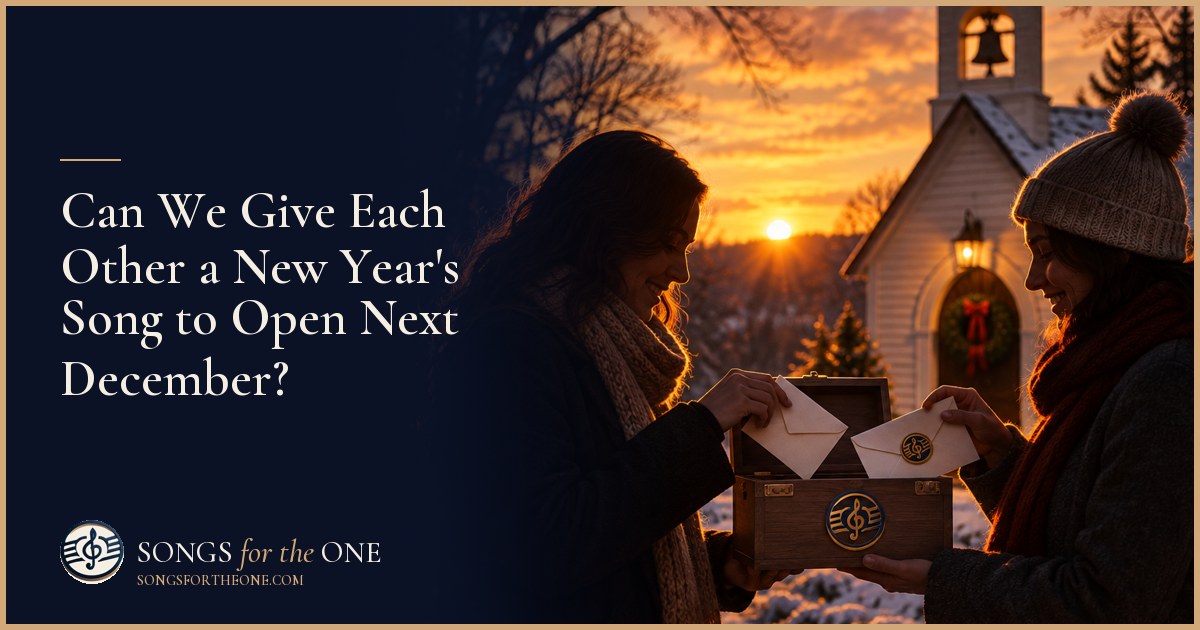
For a physical exchange, put a note explaining the listening plan and where the saved song can be found inside a sealed envelope. For a digital exchange, keep the song in your own files and send it on the agreed date. Set a reminder a week beforehand to locate the files, test playback, and confirm that you both still want to listen together.
Remember that anyone with a Songs for the One gift link can open it. Treat the link as something to share deliberately, not as password-protected storage. Leave out sensitive information you would not want passed along. Agree that neither person will post the song or share its lyrics with others without asking the other first.
What if life looks different when December arrives?
Build in permission to change the plan. Either person can ask to listen privately, postpone, or leave the song unopened. This matters for friendships as well as couples. A move, a loss, or a change in the relationship may make a once-comforting ritual feel different. Agreeing on that flexibility now keeps the future listening date from becoming an obligation.
If you do listen together, give each song room to finish before explaining it. Then ask gentle questions: “What had you forgotten about that time?” or “Which detail still feels familiar?” You do not need to compare the year against the wishes in the lyrics. The song can be accurate about how you felt then without describing everything that happened afterward.
Keep the invitation simple: “Let's each save a little of who we are right now, and hear it next December.” Choose your date, gather one ordinary memory, and decide what you want your person to remember. When you're ready, start your song and hear a free preview before deciding whether to buy the full song.
Frequently asked questions
- Should we make one song together or one for each other?
- Either works. Two separate songs preserve each person's perspective and allow a surprise, while one shared song can capture a memory and wishes you choose together.
- Can the person making the song listen before December?
- Yes. The maker can hear the preview and check the purchased song before saving it. The time capsule stays a surprise as long as the recipient waits to listen.
- Does the song have to mention New Year's?
- No. You can focus on your life at this moment and put the date in the accompanying note instead. That can make the song feel natural when heard in December.
- Can I use my own singing voice?
- Songs for the One uses AI vocals, not your voice, and does not offer voice cloning. If hearing your voice matters to the ritual, record a separate spoken introduction to save alongside the song.
- Can we make the whole exchange free?
- You can create a no-purchase version using spoken recordings or songs you already have access to, paired with personal notes. Songs for the One offers a free preview, but its full personalized song is paid.
Plan your song
Further reading
- Great questions to ask the people you loveStoryCorps
- The science of gratitudeGreater Good Science Center, UC Berkeley