
Gift ideas
Should Gifts Be Equal in Price or Equal in Personal Meaning?
· 5 min read · By the Songs for the One team
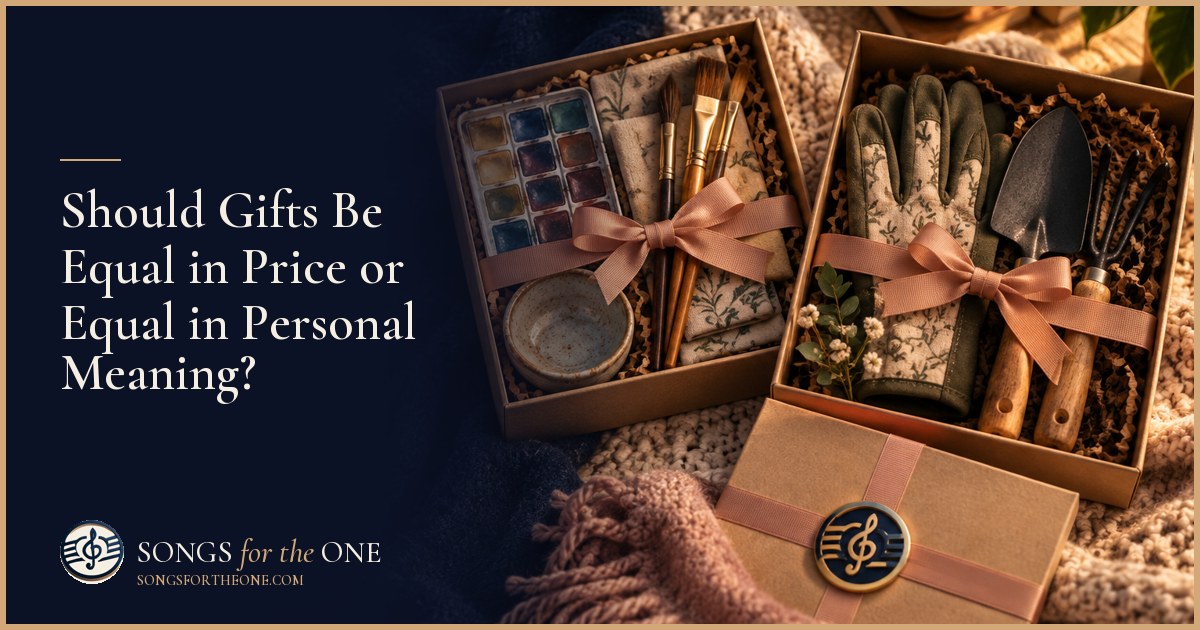
The short answer
Equal spending on gifts is not always necessary, but comparable care and respect are. Match budgets for agreed exchanges, cash gifts, or situations where differences could suggest favoritism. Otherwise, choose within a comfortable spending range, honor each recipient's preferences, and give similar attention to presentation.
Key takeaways
- Honor agreed spending limits before considering personal meaning.
- Use a budget range for comparable relationships, not a penny-for-penny rule.
- Match gifts to the recipient's preferences rather than your preferred way of giving.
- Give different gifts similar care in wrapping, timing, and presentation.
- Handle major financial help separately from a shared gift exchange.
Does fair gift-giving mean spending the same amount?
Fairness is not always identical spending. A useful starting point is comparable care: each person receives something chosen with their interests, circumstances, and relationship to you in mind. However, price still matters when recipients have reason to expect equal treatment. A thoughtful explanation cannot automatically erase a large difference that looks like favoritism.
Think of fairness as three questions: Did I respect the occasion's expectations? Did I pay attention to this person? Could the difference reasonably make someone feel less valued? For example, a hypothetical pair of siblings might happily receive a cooking class and a hiking backpack at different prices because both gifts clearly fit their interests.
The goal is not to prove that every present has an equivalent emotional value. You cannot calculate that, and recipients do not owe you a particular reaction. Instead, make choices you can explain simply and kindly without announcing prices, ranking relationships, or insisting that someone should appreciate your effort more.
When is equal spending the better choice?
Equal or closely matched spending makes sense when a group has agreed on a budget, when you are giving cash or gift cards, or when gifts are being exchanged in comparable relationships. If everyone agreed to a $30 limit, personal significance is not a reason to arrive with a $150 present. Respecting the agreement helps others participate comfortably.
Grandparents giving to grandchildren may find similar budgets especially useful when children are close in age and open presents together. The contents can still differ. For example, one grandchild might receive art supplies and another a construction set, with roughly the same spending and similar attention to what each enjoys. Matching cost does not require matching toys.
Large differences deserve a separate decision rather than a quick justification. If one relative needs help replacing a broken appliance, consider treating that as financial assistance outside the shared celebration. You do not need to disclose private circumstances, but separating support from ceremonial gifts can keep a necessary expense from becoming an apparent measure of affection.
How can you respect different preferences without overspending?
Choose a comfortable spending range before browsing. For example, a hypothetical buyer shopping for three adult relatives might set aside $40 to $60 per person. Finding a well-suited $42 gift does not create an obligation to add $18 of filler. Equally, one unusually expensive idea should not force the whole budget upward.
Then identify what each recipient actually welcomes: something useful, something consumable, time together, an experience, or a keepsake. Use evidence from their habits and requests rather than assumptions about age or personality. Someone who dislikes clutter may prefer good coffee to an engraved ornament, even if the ornament required more planning.
Personal meaning does not have to mean sentimentality. Replacing a worn kitchen tool with the exact model someone likes can show close attention. For example, if one friend loves heartfelt keepsakes while another requests a bookstore gift card, honoring both preferences is more considerate than giving both keepsakes simply because they look equally personal.
What is a quick way to compare several gifts before buying?
Make a short list with four entries per person: your spending range, one known preference, the proposed gift, and how you will present it. This gives you a workable plan when time is short. If you cannot name a relevant preference, ask a focused question such as, “Would you rather have something for cooking or an afternoon out?”
Next, compare the gifts as a group. Look for differences in money, effort, and visibility, without trying to assign numerical scores to thoughtfulness. For example, a carefully wrapped package with a long personal note may look more considered than a gift card still in its store receipt, even when the card cost more.
Fix presentation gaps before spending more. Put the gift card in a proper card with a specific note about why you chose that shop. Give a digital gift a deliberate moment rather than sending it unnoticed during dinner. Similar care in delivery can help, although matching wrapping will not solve a genuinely uncomfortable difference in value.
Finally, check availability and your total budget. Choose something you can realistically obtain or arrange, and be clear if an experience happens later. A local treat, a requested book, or a planned meal together can be a thoughtful last-minute choice. There is no need to manufacture a complicated backstory for a straightforward gift.
When does a personalized song make sense?
A personalized song can suit someone who enjoys music, memories, and being addressed directly. It is less suitable for someone who has asked for a practical item or dislikes emotional attention. For example, a hypothetical recipient who treasures stories about family road trips might welcome a song about one particular journey, while another would genuinely prefer new walking shoes.
Songs for the One makes original, AI-assisted songs for one person. You choose an occasion, then talk or type with Muse for about 3 to 7 minutes. Muse gathers who the song is for, a memory, the feeling, the musical style, and the message you want heard. You can review story notes of what Muse understood, with no songwriting skills needed. The how it works page explains the process.
The Song package costs $79 and includes the full song, an MP3 download, a gift page shared by link, a lyrics sheet, and five re-records. Songs use AI vocals, not your voice. Check the package options against your existing budget rather than treating personalization as a reason to exceed it. The core song is made in minutes, but processing time varies, so do not assume instant delivery.
How should you handle comparisons when gifts are opened?
Let your explanation focus on the recipient, not your expenditure. “You mentioned wanting to try watercolors” feels different from “Yours cost just as much as everyone else's.” Avoid public speeches about which gift took the most work. If someone raises a concern, listen first rather than telling them that caring about fairness makes them materialistic.
You can acknowledge an oversight without debating the worth of your affection. A simple “I can see why that felt uneven; I wasn't trying to make a distinction” leaves room for a private conversation. If the issue is a repeated pattern, consider a shared spending limit for future occasions. A consistent approach is more useful than a persuasive explanation every year.
Before buying, ask one final question: does each choice show that I noticed the person receiving it? If a song fits one recipient's preferences and your budget, you can start creating their song and hear a free preview before buying. The full song is paid, so the preview lets you hear the direction before deciding whether it belongs in your gift plan.
Frequently asked questions
- If I buy a gift on sale, should I spend the savings on something else?
- Usually not. A sale does not make a well-chosen gift less thoughtful, though you should follow any explicit exchange rules about actual spending.
- Should gifts for adult children always cost the same?
- Not always, but a similar budget can be helpful when gifts are given for the same occasion. Keep substantial financial help separate, and avoid assuming that a more sentimental gift automatically balances a large spending difference.
- Is it fair to give one person a homemade gift and another a purchased gift?
- Yes, if both gifts suit their recipients and the occasion's expectations. Your time matters, but it does not obligate someone to prefer a handmade item over something they requested.
- Should I tell recipients how much their gifts cost?
- Generally, there is no need to volunteer prices. Discuss spending expectations before an exchange when possible, and address concerns privately rather than comparing receipts during the celebration.
- Can I give a personalized song privately instead of playing it for everyone?
- Yes. Songs for the One includes a gift page you can share by link, allowing the recipient to choose when to listen. Anyone with that link can open it, so be thoughtful about sharing it and including sensitive details.
Plan your song
Further reading
- Great questions to ask the people you loveStoryCorps
- The science of gratitudeGreater Good Science Center, UC Berkeley