
Grandparents
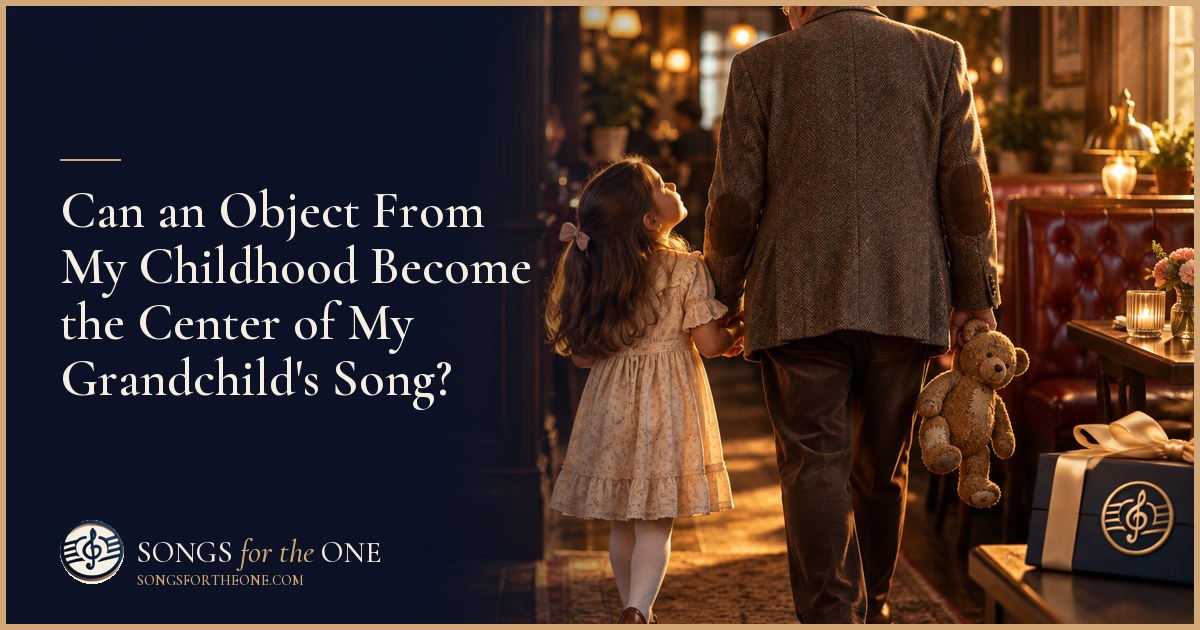
Can an Object From My Childhood Become the Center of My Grandchild's Song?
· 5 min read · By the Songs for the One team
The short answer
A childhood keepsake song can turn an object from your early life into a story your grandchild understands. Choose one clear memory, explain the feeling behind it, and connect that feeling to your grandchild’s life. The object gives the song a concrete image and a personal thread.
Key takeaways
- Choose an object with a clear memory, not necessarily monetary value.
- Build the story around one scene rather than the object’s entire history.
- Connect your childhood feeling to something your grandchild recognizes.
- End with what you want your grandchild to hear, not a lesson they must follow.
- Check the story notes and listen to the free preview before buying.
What makes a childhood object worth building a song around?
Yes, an object from your childhood can be the center of your grandchild’s song. A marble, lunch tin, sewing basket, toy boat, or recipe card gives an otherwise broad family story something specific to gather around. Your grandchild does not need to have used the object. They need to understand what happened with it and why you still remember.
Choose the object that brings back a scene most readily, rather than the one you think sounds most impressive. Ask yourself: Where was I when I used it? Who was nearby? What did I hope would happen? An everyday possession with a vivid memory often gives you more to work with than a valuable heirloom whose history you barely know.
For example, a hypothetical grandfather might remember a chipped toy boat because he kept setting it afloat after it tipped over. The useful story is not simply that the boat is old. It is that a child beside a puddle wanted to try again. That feeling can reach a grandchild who has never sailed anything.
How do I turn the object into a story my grandchild can follow?
Use a five-part structure: object, scene, feeling, connection, message. First name the object in ordinary language. Then place yourself in one moment with it. Explain what you felt, connect that feeling to your grandchild, and finish with what you want them to hear. This keeps the song from becoming an inventory of family possessions.
You can prepare by completing five short sentences: “The object was…” “I remember the day…” “At the time, I felt…” “This makes me think of you because…” “What I want you to know is…” Speak the answers aloud if that feels easier than writing. A few clear sentences are enough to begin; you do not need to compose verses or find rhymes.
For example, a hypothetical grandmother could describe a small red suitcase she carried on her first overnight visit away from home. She might remember its stiff handle, the unfamiliar bedroom, and feeling both excited and nervous. Her connection could be a grandchild preparing for a first sleepover. Her message might be that missing home and enjoying a new experience can happen together.
Which details help without overwhelming the song?
Keep two or three details that let your grandchild picture the moment. A rattling latch, a patch sewn onto a sleeve, or the smell of a wooden drawer can do more than several dates and addresses. Include names when they matter emotionally, but explain relationships. “My dad, your great-grandfather” gives a listener more footing than an unfamiliar first name alone.
Translate unfamiliar objects through what they did. For example, if your hypothetical story centers on a wind-up kitchen timer, explain that you turned its dial and waited for the bell while bread baked. You do not need to describe its mechanism. Give enough context for your grandchild to enter the kitchen with you, then return to the people and the feeling.
Keep remembered facts separate from guesses. If you cannot recall whether you were seven or eight, say “when I was little.” If the object has been lost, describe what you genuinely remember rather than filling gaps. The song can carry a truthful family memory without becoming a precise historical record.
How do I make it about my grandchild, not just my past?
The object can be the center of the story while your grandchild remains the reason for telling it. Look for a shared feeling rather than an identical experience. Waiting, belonging, curiosity, disappointment, and pride are understandable across generations. You do not need to claim that your childhood and your grandchild’s life are the same.
For example, a hypothetical grandparent’s well-used pencil box could hold a memory of being nervous in a new classroom. If their grandchild is changing schools, the connection is uncertainty, not a comparison between school then and now. A message such as “You can take your time getting comfortable” offers reassurance without promising that every day will be easy.
Match the explanation to the recipient. A young child may enjoy the object’s sound, color, and a simple action. A teenager or adult grandchild may appreciate why you kept it or how your understanding changed. Avoid making the keepsake an obligation. “I wanted you to know this part of me” leaves more room than “You must treasure this forever.”
How can I turn these notes into a song with Songs for the One?
Songs for the One makes original, personalized songs, AI-assisted. After choosing an occasion, you talk or type with Muse, a guide, for about 3 to 7 minutes. No songwriting or music skills are needed. You can see how the process works before beginning, then bring your object, scene, feeling, connection, and message into the conversation.
Muse gathers five Song DNA elements: The One, The Moment, The Feeling, The Sound, and The Message. For this song, The One is your grandchild, and The Moment is your chosen childhood scene. The Sound is the musical style you want. You also see story notes of what Muse understood, so review who owned the object, whose memory it is, and how it connects to your grandchild.
The song uses AI vocals, not your own voice, and you hear a free preview before buying. The full song is paid; The Song package costs $79. Every paid song includes an MP3 download, a gift page shared by link, a lyrics sheet, and five re-records. You can review the packages and pricing if you want to compare options.
How should I share the song and the object?
If you still have the object, consider showing it before playing the song. Let your grandchild notice its size, weight, or worn places, then give a short introduction: “I used this when I was about your age, and there’s something I wanted to tell you about it.” There is no need to explain the whole story before they hear it.
If you no longer have it, a photograph or a spoken description can provide the same starting point. You do not have to hand down ownership for the memory to matter. Also consider privacy when sharing: anyone with the gift link can open it. Choose details you are comfortable including, especially when the memory involves other relatives.
Start with the object that brings one clear moment to mind. Gather a few sentences about what happened and why you want your grandchild to know. When you are ready, create your grandchild’s song and hear the free preview before deciding whether to buy the full song.
Frequently asked questions
- Can I use an ordinary object instead of an heirloom?
- Yes. An everyday object can carry a strong story when you remember a specific moment connected to it. Its usefulness to the song comes from the memory, not its age or monetary value.
- What if my grandchild has never seen the object?
- Describe what it looked like and what you used it for in one or two plain sentences. Connect it to a familiar feeling so your grandchild can understand why it matters.
- Can the song include more than one childhood object?
- It can, but one main object usually makes the story easier to follow. Include a second only if it belongs to the same scene or helps explain the message.
- What if the object brings back a sad memory?
- You can include sadness without giving your grandchild responsibility for easing it. Choose details appropriate to their age and explain why you want to share the memory with them.
- Will the song sound like me singing?
- No. Songs for the One uses AI vocals, not your voice, and does not offer voice cloning. You can introduce the song yourself to add your own spoken voice to the moment.
Plan your song
Further reading
- Great questions to ask the people you loveStoryCorps
- Friends and family advice for grandparentsAARP
- The science of gratitudeGreater Good Science Center, UC Berkeley