
Grandparents
What Can I Give My Grandchild to Remember Our Family Home Before I Sell It?
· 5 min read · By the Songs for the One team
The short answer
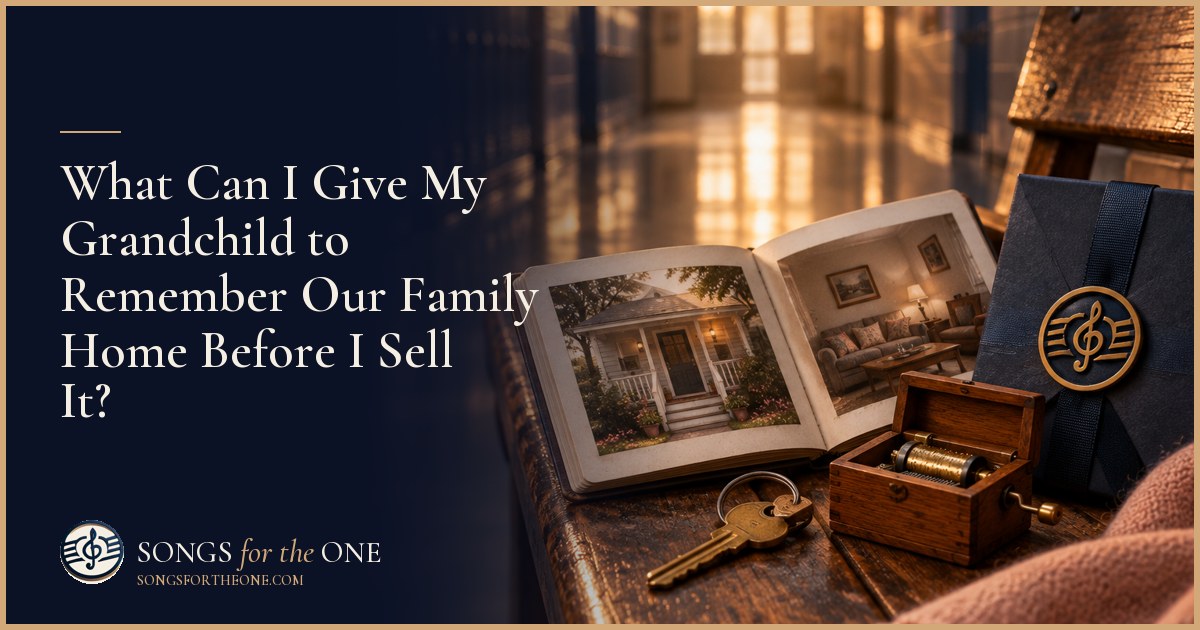
Small family home keepsakes can help your grandchild remember the house without storing its furniture. A room-by-room booklet preserves familiar places, an everyday object offers something tangible, and a song recalls shared moments. Choose the format around what your grandchild remembers and has room to keep.
Key takeaways
- Ask your grandchild which places and routines they remember before choosing a keepsake.
- Make a short booklet with room photographs and one shared memory per page.
- Offer one familiar household object without attaching an obligation to keep it forever.
- Choose a song when the voices, routines, and feelings matter more than the furnishings.
- Keep a backup of digital files and give a little context with physical objects.
What will help my grandchild remember the house most?
Start with the life your grandchild knew inside the house, rather than the possessions you need to move out. Your memories may center on buying the dining table or planting the garden. Theirs may be about hiding beneath that table or being allowed to pick tomatoes. Neither version is more important, but their version can help you choose a gift they recognize immediately.
Ask a simple question: “What would you like to remember about being here?” If that feels too broad, ask where they liked to sit, what they liked doing, or which sound meant they had arrived. For example, a grandchild might remember the back door's squeak more clearly than the formal sitting room. Write down their actual words, with permission, rather than polishing away their personality.
Then consider how they like to revisit memories. A child who enjoys photographs may appreciate a booklet. Someone who cooks may welcome a familiar utensil. A grandchild who often listens to music may enjoy a song. You can offer these choices without making them responsible for preserving the entire household or reassuring you about the sale.
How do I make a room-by-room memory booklet?
A booklet is the strongest option when you want to preserve what the house looked like and where things happened. Choose four to eight meaningful places, not necessarily every room. The front step, a hallway height chart, or the patch of garden where you played together may deserve a page more than a spare bedroom.
Give each place a photograph and a short memory. A useful pattern is: what happened here, one sensory detail, and what you appreciated about being together. For example, a hypothetical kitchen page could describe stirring pancake batter on Saturday mornings, flour on a sleeve, and the grandchild's insistence on making the smallest pancake for you. A few precise sentences are enough.
Photograph these places before packing changes their appearance, if possible. Include a wide view and a close-up of something familiar. Print a simple stapled booklet or place the pages in a small album, then save a digital copy. The trade-off is the time needed to select and arrange everything. Keep the project manageable by setting a page limit before you begin.
Which ordinary household object makes a meaningful keepsake?
An everyday object works well when your grandchild has used it with you. Think of a biscuit cutter, a small garden tool, a card-game score pad, or a familiar serving spoon. Its value comes from recognition and use, not its price. For example, the mixing bowl used together every holiday may carry more meaning than a decorative piece your grandchild was never allowed to touch.
Offer rather than assign it: “Would you like this, or would a photograph of it be better?” Check that it is safe, practical to transport, and suited to their home. For a young child, speak with their parent before giving anything fragile, sharp, or difficult to store. If several grandchildren want the same item, discuss it openly rather than turning the choice into a test of affection.
Add a small note explaining the connection, including an approximate date if useful. You might describe what you made together or where the object usually lived. This option takes little preparation, but even a small object occupies space and may eventually break. Say clearly that they may use it, pass it on, or let it go without losing the memory.
When is a song a better choice than something to store?
A song is worth considering when the memory is mostly about shared routines and the feeling of being together. It can connect moments from different rooms without requiring another box or shelf. It does not document the house as precisely as a booklet, and it is not something to hold. Its strength is bringing selected memories into something your grandchild can listen to again.
With Songs for the One, you choose an occasion and talk or type with Muse, a guide, for about 3 to 7 minutes. Muse gathers who the song is for, a memory, the feeling, the musical style, and what you most want your grandchild to hear. You can see story notes of what Muse understood. No songwriting or music skills are needed; the original song is AI-assisted and sung with AI vocals, not your voice.
For example, a song could connect muddy boots by the back door, a favorite chair during thunderstorms, and the message that your welcome continues at your next home. Choose a style your grandchild enjoys rather than one that merely sounds nostalgic to you. You can explore how the process works. The Song package costs $79 and includes the full song, an MP3 download, a gift page, a lyrics sheet, and five re-records. You hear a free preview before deciding whether to buy.
How do I choose without creating another storage obligation?
Use three practical questions: What will they revisit? What can they comfortably keep? What can you reasonably finish before moving? A booklet is best for visual detail, an object for a familiar physical connection, and a song for shared moments expressed through music. The booklet involves selection and layout; the object needs space; the song involves listening preferences and a paid purchase if you want the full version.
You do not need all three. One thoughtful keepsake can do more than a large collection handed over during moving week. A modest combination can work, though. For example, you could tuck a photograph of your baking afternoons beside the serving spoon, or give a short booklet alongside a song. Let each element add something different rather than repeating the same material.
Consider access as well as size. Give printed photographs a protective home and keep copies of the original files. If you buy a song, download the MP3 and save a backup somewhere you can find it. Anyone with its gift link can open the page, so avoid including sensitive family information or circulating the link more widely than you intend.
What should I say when I give the keepsake?
Keep the explanation direct: you wanted your grandchild to have a way to remember time spent together in this house. You can acknowledge that selling brings mixed feelings without asking the gift to resolve them. For example, you might say, “I'll miss our afternoons here. I wanted you to have this because they mattered to me.” Leave room for whatever response comes.
If possible, give the keepsake during a quiet visit rather than amid loading boxes. Walk through a favorite room or sit together for a few minutes, but do not require a ceremonial goodbye. A younger child may want to play; an older grandchild may prefer to look or listen later. Neither response tells you how much the relationship means to them.
The central message can be simple: the address is changing, but being their grandparent is not. Choose the keepsake that makes that message feel natural. If a song fits the memories you want to share, start a song for your grandchild and hear a free preview before buying the full song.
Frequently asked questions
- What if my grandchild is too young to remember the house?
- Make a small photo booklet with names, approximate dates, and simple descriptions of what you did together. Give it to their parent for safekeeping, without expecting the child to understand its significance yet.
- Can I make a keepsake after the house has already sold?
- Yes. Use photographs you already have, draw a simple floor plan from memory, or write down familiar routines. You do not need access to the house to preserve what happened there.
- Should each grandchild get the same keepsake?
- Not necessarily. You can use the same basic booklet with a different personal page for each grandchild, or offer different objects based on shared activities. Explain that the choices reflect individual memories, not a ranking.
- What if my grandchild does not want any household objects?
- Accept that without treating it as a rejection of the family. Ask whether photographs, a booklet, or a song would appeal, and allow them to decline those too.
- Will a personalized song use my own singing voice?
- No. Songs for the One uses AI vocals and does not offer voice cloning. If hearing your actual voice matters, you can separately record yourself telling a memory to accompany the keepsake.
Plan your song
Further reading
- Great questions to ask the people you loveStoryCorps
- Friends and family advice for grandparentsAARP
- The science of gratitudeGreater Good Science Center, UC Berkeley