
Grandparents
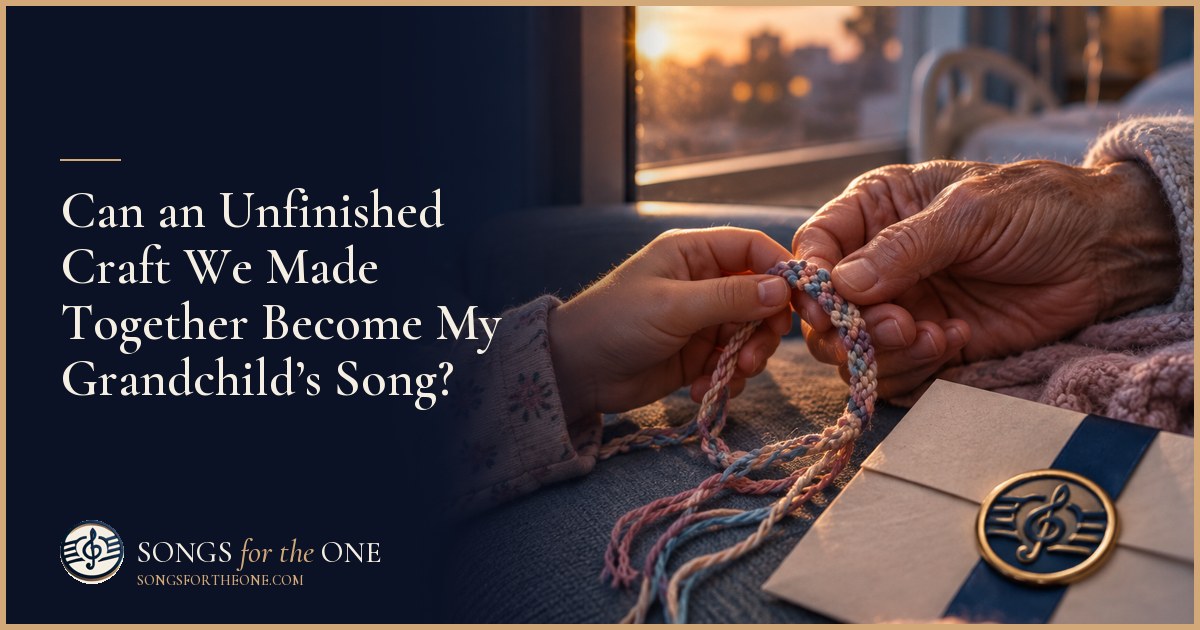
Can an Unfinished Craft We Made Together Become My Grandchild’s Song?
· 5 min read · By the Songs for the One team
The short answer
A song about an unfinished craft can preserve the time you shared with your grandchild without pretending the project was completed. Materials, small experiments, remembered conversations, and your message of affection give the song its substance. The ending can honor being together rather than finishing the object.
Key takeaways
- Use real materials, small attempts, and remembered moments as the song’s details.
- Tell the songwriter explicitly that the project was never finished.
- Keep your grandchild’s experience separate from feelings you cannot know.
- End with what the time meant to you, not a promise to finish.
- Check the free preview for invented details before buying the full song.
Can an unfinished project really carry a whole song?
Yes. A shared craft does not need to become a finished keepsake to hold a meaningful memory. The song can be about sitting beside your grandchild, working something out, and paying attention to each other. A loose roof, an unsewn seam, or a box of paper shapes can belong in that memory exactly as it was. You do not have to improve the facts to make them worth sharing.
For example, suppose you and your grandchild started a wooden birdhouse, tried three paint colors, and put everything away before attaching the roof. The strongest detail might not be the birdhouse at all. It might be your grandchild carefully painting a scrap of wood while you held the paint pot steady. That is a small, specific moment a song can return to.
The emotional center is what you want your grandchild to know now. Perhaps it is, “I liked having that afternoon with you,” or, “Your ideas mattered to me.” These are messages about your relationship, not judgments about the work. The unfinished object gives the song a setting; your affection gives it a purpose.
Which details should I gather before starting?
Start with a short inventory rather than a polished story. Name what you were making, where you worked, and two or three materials you remember. Include one action: measuring, unpicking, mixing, sanding, folding, or testing. These ordinary verbs help describe what actually happened. You can look at the remaining supplies if you have them, but the object does not need to survive for the memory to count.
Next, choose one detail that feels particular to the two of you. For example, a hypothetical sewing project might include yellow fabric, a tin of mismatched buttons, and the way your grandchild rearranged the buttons before choosing any. You do not need every step. A few accurate details leave more room for the message than a complete account of the afternoon.
Separate certainty from guesswork. If you remember laughter but not the joke, say that. If you cannot recall the color of the yarn, leave it out. Use quotation marks only for words you genuinely remember. A useful note might read: “We kept trying different shapes. I remember enjoying that, but I don’t remember exactly what either of us said.”
How do I avoid turning it into a story about failure?
Describe the unfinished state plainly, without assigning blame. “We put the pieces back in the box” is different from “You gave up.” Unless the reason matters to your message, the song does not need to explain why work stopped. An afternoon can end because it is time to go home. A hobby can lose its appeal. Neither requires a lesson about perseverance.
Keep your own feelings distinct from your grandchild’s. You can say you treasured the time; you cannot necessarily say they considered it their happiest afternoon. For example, if a hypothetical clay project cracked and your grandchild was disappointed, avoid asking the song to declare that the crack made everything better. It can acknowledge disappointment while expressing that you still valued being together.
Give a clear boundary for the ending: “Do not describe the project as finished, displayed, worn, or used.” Then say what should take its place. That could be gratitude for the time, appreciation for an idea your grandchild tried, or a simple expression of love. A song can reach an emotionally complete ending while leaving the physical project unfinished.
How would I turn these memories into a song?
With Songs for the One, you choose an occasion and talk or type with Muse, a guide, for about 3 to 7 minutes. You do not need songwriting or music skills. The service creates original, AI-assisted personalized songs with AI vocals, not your voice. The how it works page explains the process if you would like to understand it before sharing your memory.
Muse gathers five Song DNA elements: The One, The Moment, The Feeling, The Sound, and The Message. For this song, those mean your grandchild, a specific scene from the project, the feeling you want to convey, a musical style, and what you most want them to hear. Choose a sound that suits the recipient and the memory rather than assuming every grandchild needs a playful children’s song.
For example, a hypothetical starting note could be: “This is for my teenage grandson. We began a model boat at my kitchen table but never fitted the sail. I remember him testing how it balanced. Keep the sound gentle and acoustic. I want him to know I enjoyed listening to his ideas. Please don’t invent a launch.” You will see story notes of what Muse understood; check that they preserve this distinction.
What should I listen for in the free preview?
Listen first for truth, not just a pleasing tune. Does the song keep the object unfinished? Does it use your actual details without adding a triumphant result? For example, a hypothetical song about an incomplete quilt should not suddenly place it across a bed. Even a lovely image can change the meaning if it describes something that never happened.
Then listen for emotional pressure. Notice whether the words imply your grandchild owes you another craft afternoon, should regret stopping, or must keep the object forever. Your intended message may be much simpler: you enjoyed their company. Also check that the language suits their age now and sounds like something you would be comfortable saying to them directly.
Songs for the One offers a free preview before you buy; the full song is paid. The Song package is $79 and includes the full song, an MP3 download, a gift page shared by link, a lyrics sheet, and five re-records. You can review the package options without adding artwork or video. The core song is made in minutes, though processing time varies.
How can I give the song without promising we will finish?
Introduce it with one honest sentence. For example: “I made this song because I still think about our afternoon with that box of supplies.” You can share it alongside a photograph or one remaining piece, but neither is required. If the materials are gone, avoid apologizing for their absence. The gift is your account of the time and what it meant to you.
If you hope to work together again, make that an invitation rather than the song’s promised ending. “I’d enjoy making something with you again” leaves room for a different interest or project. Share the gift link thoughtfully, too: anyone with that link can open it. A direct message may suit a personal memory better than posting it in a large family group.
You do not need to find the missing piece or complete the craft before beginning. Gather a few true details, name what stayed with you, and start your grandchild’s song. You can hear a free preview before deciding whether to buy the full song, and consider whether it honors the afternoon you actually shared.
Frequently asked questions
- What if I no longer have the unfinished project?
- You can build the song from what you remember about the materials, the activity, and your time together. Leave uncertain details out rather than replacing them with something plausible.
- Should I ask my grandchild what they remember?
- You can, especially if you want the song to reflect both perspectives. If it is a surprise, keep the song grounded in your own memories and feelings rather than claiming to know theirs.
- Can the song include frustration or a mistake?
- Yes, if that detail matters and will not embarrass your grandchild. Describe it kindly and accurately without forcing it into a lesson or claiming everyone enjoyed the difficulty.
- Will the song sound like me singing?
- No. Songs for the One uses AI vocals, not your voice, and does not offer voice cloning. Your contribution is the memory, musical preferences, and message.
- Can this work for an adult grandchild?
- Yes. You can revisit a childhood project while speaking to your grandchild as the adult they are now. Choose language and a musical style that suit them today.
Plan your song
Further reading
- Great questions to ask the people you loveStoryCorps
- Friends and family advice for grandparentsAARP
- The science of gratitudeGreater Good Science Center, UC Berkeley