
Weddings
Can I Have a Father-Daughter-Style Dance With My Grandfather or Brother?
· 5 min read · By the Songs for the One team
The short answer
A wedding dance with grandfather or your brother can take the place of a father-daughter dance. Choose wording that reflects your actual relationship, and ask the host to introduce you by name or family connection. You do not need to explain your family circumstances to guests.
Key takeaways
- Call it a special dance or name the relationship instead of using a father-daughter label.
- Check every verse for romantic language and inaccurate childhood claims.
- Give your host one approved introduction with no family backstory.
- Confirm the song file, stopping point, and dance partner's comfort before the reception.
Can my grandfather or brother join me instead of my father?
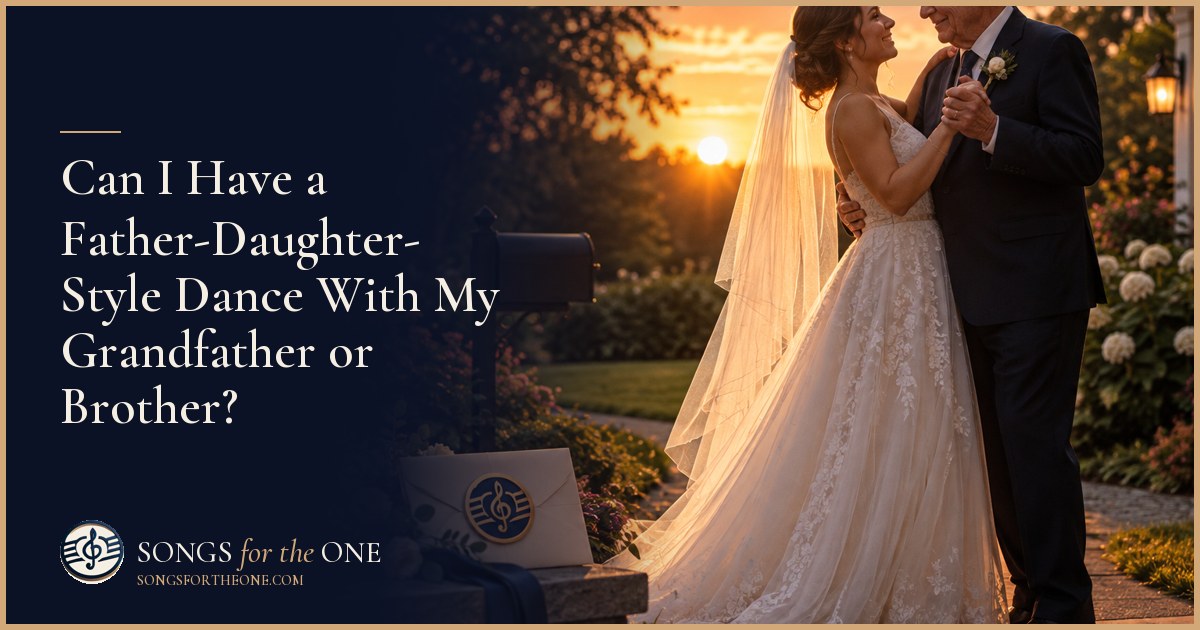
Yes. You can share this wedding dance with the person you actually want beside you, including your grandfather or brother. The familiar father-daughter format is an option, not a requirement that determines who belongs on the floor. You can keep the quiet, meaningful moment and change its name, music, and introduction to match your relationship.
You also do not have to describe your chosen partner as a replacement father. A grandfather can be honored as your grandfather. A brother can be celebrated for being your brother. Whether your choice involves loss, distance, a complicated relationship, or simply closeness with someone else, the microphone does not need to carry that explanation.
Ask your dance partner privately before adding the moment to the schedule. For example, you might say, “I'd love to share a short dance with you at the reception. Would that feel good to you?” Tell him whether you imagine a slow sway, an upbeat turn around the floor, or just one verse and a chorus. That makes the invitation clear without making it feel like an assignment.
What should we call the dance, and how should the host introduce it?
Use “a special family dance,” “a dance with her grandfather,” or “a dance with her brother.” You can also skip a category entirely and have the host announce the two people sharing the moment. If your reception schedule currently says “father-daughter dance,” ask the coordinator to update the DJ's notes and any printed program that has not yet been produced.
For example, a grandfather introduction could be: “Please welcome Maya and her grandfather, Luis, to the dance floor for a special song.” A brother introduction could be: “Maya has chosen to share this next dance with her brother, Daniel. Please join us in welcoming them.” Both tell guests everything they need to know without suggesting that someone is missing or being replaced.
Send the wording in writing, including name pronunciations, and ask the host not to improvise a family explanation. Phrases such as “stepping in,” “in her father's place,” or “the man who really raised her” can reveal more than you intended. If you want to mention someone who has died, make that a separate, deliberate decision rather than an assumed part of the introduction.
How do I choose lyrics that fit a grandfather or brother?
Listen to the entire song, not just the chorus or the excerpt you remember. Check who is speaking, who is being addressed, and what the song claims about their relationship. A familiar melody may feel right while a later verse describes romantic attraction, a father watching his daughter grow up, or a lifetime of experiences that do not belong to you.
For a grandfather, accurate themes might include shared routines, his encouragement, or a memory you both recognize. For example, if it is true for you, a reference to Saturday breakfasts can say more than a sweeping claim that he was present for every milestone. Avoid parental titles unless you actually use them and want them heard publicly.
For a brother, look for sibling friendship, shared humor, loyalty, or the experience of growing into adulthood together. Do not automatically frame him as your protector or someone who raised you, especially if he is younger. A useful lyric test is: “Would I say this sentence directly to him without explaining what I meant?”
An instrumental is an honest alternative when words keep getting in the way. So is a shared favorite whose complete lyrics you have checked. The song does not need to mention a wedding or your family relationship to work. Your introduction can establish the connection while the music gives you room to enjoy it.
Can a personalized song make the wording more accurate?
A personalized song can help when you want the music to name your real relationship rather than borrow someone else's story. Songs for the One makes original, AI-assisted songs for one person. You choose an occasion, then talk or type with Muse, a guide, for about three to seven minutes. No songwriting or music skills are needed.
Muse gathers five Song DNA elements: The One, The Moment, The Feeling, The Sound, and The Message. For example, your notes could identify your brother, recall a shared kitchen-table joke, request a grateful rather than solemn mood, choose an acoustic style, and say that the central message is “I'm glad you're beside me.” Specify that this is a bride-to-brother wedding dance, not a romantic song or a father-daughter song.
You see story notes showing what Muse understood. Check names, relationship labels, and memories, and use the free preview to assess the wording, mood, and sound before buying. Songs use AI vocals, not your voice, and do not use voice cloning. You can review how the process works and current packages; the core Song package is $79, and the full song is paid.
What should I do if the wedding is very soon?
Focus on three decisions first: who is dancing, what the host will say, and which playable audio file the DJ will use. A simple shared dance needs no choreography or elaborate reveal. Choose an existing song or instrumental as a backup while you assess any custom option, so the reception plan does not depend on unfinished audio.
The core Songs for the One song is made in minutes, but processing time varies, so do not treat that as guaranteed instant delivery. Every paid song includes an MP3 download, lyrics sheet, shareable gift page, and five re-records. A full song is usually about 2:40 to 3:40. Leave time to listen through it and send the downloaded file to your DJ.
Ask the DJ to confirm that the file opens and agree on a clear fade point if you want a shorter dance. Optional videos and streaming take three to five business days after materials are received, and streaming acceptance varies, so they should not be dependencies for an imminent reception. You can keep this moment focused on the music.
How can we make the moment comfortable rather than complicated?
Give your partner a little practical information: where to wait, who will invite him onto the floor, and how the dance ends. Ask about pace and comfort rather than assuming what he can manage. A gentle sway, a shorter excerpt, or an invitation for other family members to join afterward can all work if that is what you both want.
Tell the photographer and coordinator about the plan, too. For example, you could request a few photographs of the two of you without asking the host to hold a long introduction. If relatives ask why you chose this dance, a calm response is enough: “This is a moment I wanted to share with him.” You do not need to defend the choice.
The goal is a song you can stand behind and an introduction that lets the moment begin naturally. If specific words would make that easier, start your song and hear a free preview before deciding whether to buy the full song.
Frequently asked questions
- Can I dance with both my grandfather and my brother?
- Yes. You can plan two short dances or agree on a handoff during one song. Give both partners and the DJ the timing beforehand so nobody has to guess.
- Is it okay to choose my brother if my father is attending?
- Yes. You can choose whom you dance with. If you anticipate hurt feelings and a private conversation feels appropriate, discuss the plan beforehand rather than using the reception announcement to explain it.
- Does this dance have to match the length of another family dance?
- No. You can choose different lengths for different dances. A clear stopping point and a comfortable experience matter more than equal minutes.
- Can we keep a personalized dance song private?
- You can choose not to share the gift-page link widely, but anyone who has that link can open it. Keep sensitive family details out of lyrics that will be played at the reception.
- Do we need dance lessons?
- No. Agree on a comfortable hold, try swaying together, and practice how you will finish. Lessons are optional if you both want more structure.
Plan your song
Further reading
- Great questions to ask the people you loveStoryCorps
- The science of gratitudeGreater Good Science Center, UC Berkeley