
Grandparents
Can a Family Recipe Tell a Bigger Story in My Grandchild’s Song?
· 5 min read · By the Songs for the One team
The short answer
A family recipe song can tell your grandchild a bigger story by connecting a dish to the person, place, or act of care behind it. Choose one memory, a few sensory details, and a clear message. Let the food introduce the relationship rather than explain the cooking.
Key takeaways
- Choose the person or act of care behind the dish before describing its ingredients.
- Build around one kitchen memory and two or three recognizable details.
- Tell your grandchild why the memory matters and what you want them to hear.
- Keep cooking instructions on a separate recipe card.
- Use the free preview to check whether the song captures the relationship.
How can a recipe become a story instead of a list of ingredients?
Yes, a family recipe can carry a much bigger story. A dish often brings a whole scene with it: who stood at the stove, where everyone sat, and how someone made sure there was enough. For your grandchild’s song, those connections matter more than the measurements. The food gives the memory a familiar doorway, but the relationship gives it meaning.
Start by finishing this sentence in ordinary language: “When I think of making this for you, I remember…” You might recall a visit, a weekly routine, or the first time your grandchild wanted to help. Then ask what that moment shows. Was it patience, welcome, pride, or simply the pleasure of being together? That answer helps keep the song from becoming a musical recipe card.
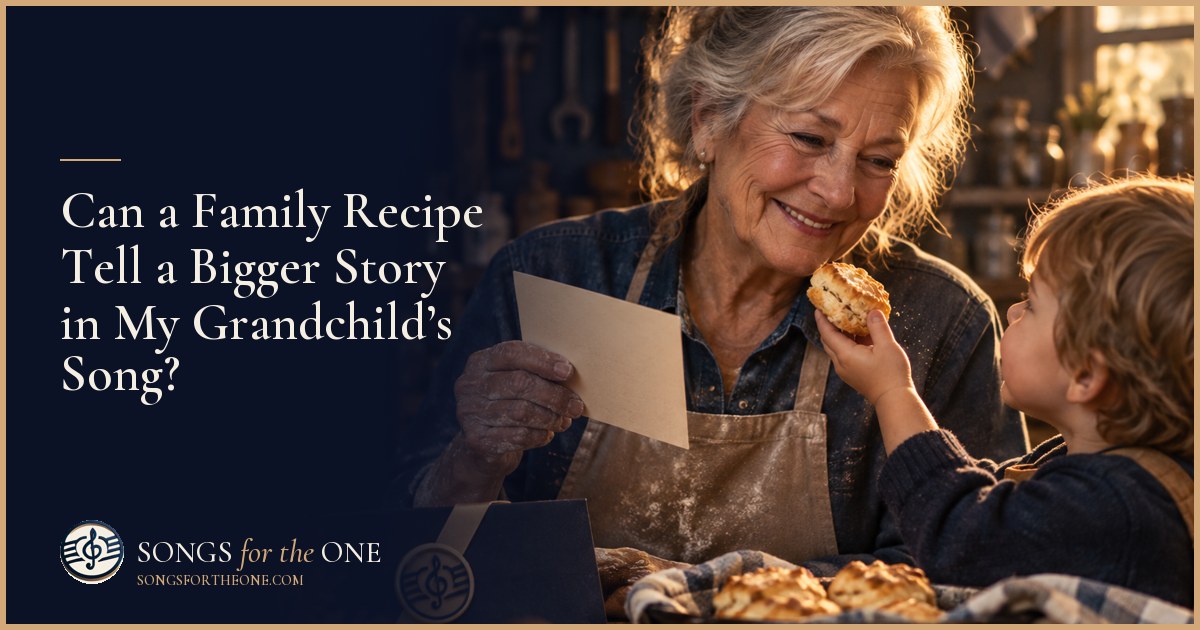
For example, a hypothetical memory of making biscuits could focus on a grandchild pressing one crooked shape into the dough. The important detail is not the oven temperature. It is that you put their biscuit on the tray alongside yours, giving their effort a place at the table.
Which person or act of care should I connect to the dish?
Choose the connection you most want your grandchild to understand. It might be the relative who taught you the recipe, the kitchen where you first made it, or something you do whenever your grandchild visits. You do not need to tell the entire family history. One person and one revealing action can give the song a clear center.
For example, if your father always wrapped an extra portion for someone to take home, the story might be about looking after people even after they left the table. You could explain that you now do the same for your grandchild. This connects generations through a recognizable act of care, without requiring a long account of who cooked what and when.
Keep your grandchild in the foreground, even when an older relative belongs in the story. Explain why you are sharing that person’s memory with them now. Perhaps you recognize the same generosity in your grandchild, or you want them to know where a familiar habit began. Avoid turning the gift into an obligation to keep cooking the dish forever.
What kitchen details will help my grandchild recognize the memory?
Choose two or three details that belong to your actual experience. A chipped yellow bowl, the chair your grandchild dragged to the counter, or the sound of a lid rattling can establish a setting quickly. Prefer details that connect to someone’s actions. A flour-covered sleeve says more when it belongs to the child who insisted on doing the mixing.
For example, you might describe a hypothetical rainy afternoon when your grandchild helped fold dumplings, then lined up the misshapen ones with particular pride. The rain, the uneven folds, and your shared laughter are enough to make a scene. Adding every filling ingredient and each preparation step would compete with the moment rather than deepen it.
If your grandchild never knew the person who first made the dish, make the connection explicit. Instead of relying on a name alone, explain the relationship and one meaningful habit. You can say that your aunt taught you to make room for an unexpected guest. There is no need to invent dialogue or reconstruct a scene you cannot clearly remember.
How do I find the message underneath the memory?
Ask yourself what you want your grandchild to understand after the song ends. The message might be “There is always a place for you here,” “I love the person you are becoming,” or “Our ordinary afternoons together matter to me.” Choose the statement that feels true to your relationship, not the one that sounds most impressive.
Then check whether the memory supports that message. For example, a hypothetical story about setting aside a portion before a grandchild arrives naturally supports a message of welcome. A memory of patiently trying again after a batch went wrong might support encouragement. You do not need to explain the lesson repeatedly if the scene already shows it.
Leave space for your grandchild’s own tastes and future. They may never cook the recipe, and the song can still mean a great deal. You can share what you hope they carry forward, such as hospitality or time together, without asking them to recreate your life. The gift is your affection and perspective, not a set of family duties.
How do I share the recipe story with Songs for the One?
With Songs for the One, you pick an occasion and then talk or type with Muse, a guide, for about 3 to 7 minutes. No songwriting or music skills are needed. Muse gathers five Song DNA elements: The One, The Moment, The Feeling, The Sound, and The Message. You can see story notes of what Muse understood. The how it works page explains the process.
For this kind of song, prepare a short note covering who your grandchild is, one memory around the dish, the feeling you associate with it, a musical style, and your main message. For example: “This is for my grandson. We make soup when he visits on Sundays. He always sets out two spoons before I ask. I want a warm acoustic sound, and I want him to know how much I value that time.”
Add a clear direction such as, “Mention the soup, but focus on our visits rather than the cooking steps.” Read the story notes for names, relationships, and the emotional emphasis. The songs are original and AI-assisted, with AI vocals rather than your own voice. The core song is made in minutes, though processing time varies.
How can I give the song alongside the recipe?
Let the song and recipe do different jobs. The song can hold the memory and message, while a handwritten or printed card preserves the ingredients and method. For example, you could give your grandchild the recipe card with a familiar serving spoon, then listen to the song together. A simple presentation is enough.
Every paid song includes the full song, an MP3 download, a gift page shared by link, a lyrics sheet, and five re-records. The Song package is $79, and you can compare options on the pricing page. Anyone with the gift link can open it, so keep that in mind when deciding which personal family details to include.
When you hear the free preview, listen for the relationship: does the food lead toward something you want your grandchild to know? If the emphasis needs changing, identify the specific detail or message you want to bring forward. When you are ready, start your grandchild’s song and hear a free preview before deciding whether to buy the full song.
Frequently asked questions
- Can I use a dish that does not have a written recipe?
- Yes. A dish made from memory can anchor the song just as well as a recipe on paper. Describe what your grandchild would recognize and the time you shared around it.
- What if my grandchild has never tasted the family dish?
- Use the dish to introduce someone or somewhere important to you. Explain why you want your grandchild to know that story, rather than assuming the food already has meaning for them.
- Should I include a secret family ingredient in the song?
- Only if you are comfortable sharing it. Anyone with the gift link can open the gift page, and a meaningful song does not require the complete recipe.
- Can the song mention a relative who has died?
- Yes, if that feels right for your relationship with your grandchild. A familiar habit or affectionate memory can honor the person while keeping the song centered on what you want to share with your grandchild.
- Will the song sound like me singing to my grandchild?
- No. Songs for the One uses AI vocals, not your voice, and does not offer voice cloning. Your memories and message personalize the song.
Plan your song
Further reading
- Great questions to ask the people you loveStoryCorps
- Friends and family advice for grandparentsAARP
- The science of gratitudeGreater Good Science Center, UC Berkeley