
Grandparents
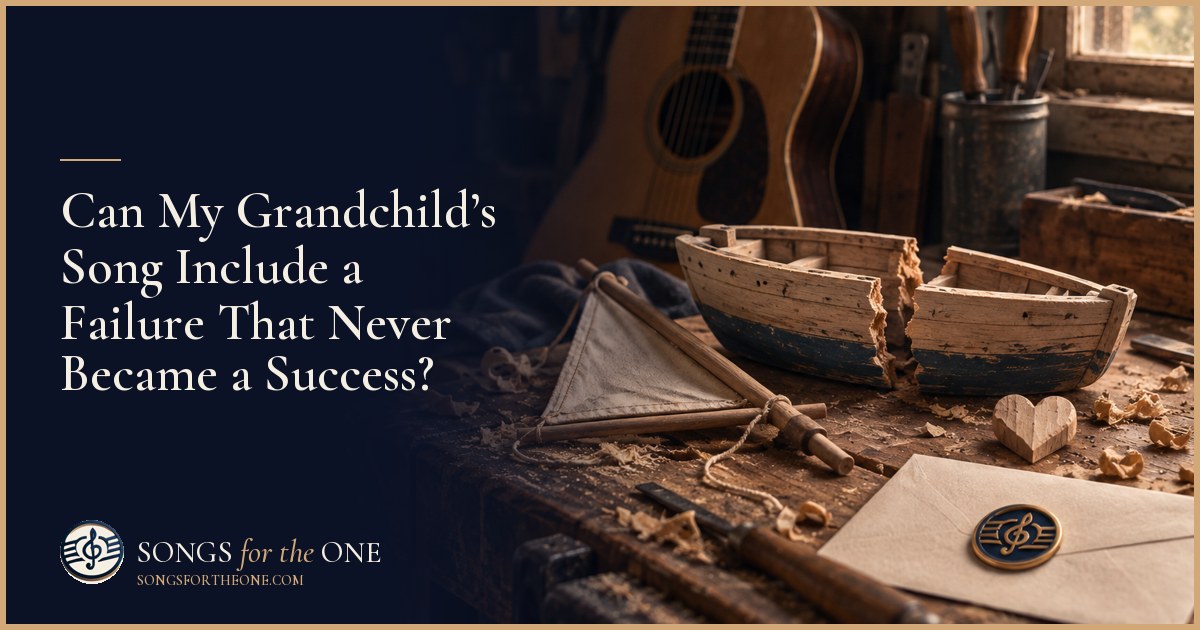
Can My Grandchild’s Song Include a Failure That Never Became a Success?
· 5 min read · By the Songs for the One team
The short answer
Yes, a song about failure can tell your grandchild the truth without turning disappointment into success. You can describe what happened, acknowledge what remained lost, and share what you believe now. The song can end with love and acceptance rather than a lesson that makes everything worthwhile.
Key takeaways
- State what happened without adding a later victory that did not occur.
- Separate what you learned from whether the loss was worthwhile.
- Choose details your grandchild can receive without feeling responsible for comforting you.
- End with your relationship or a present belief, not a forced silver lining.
- Use the free preview to check whether the song preserves your intended meaning.
Does a failure need a happy ending to belong in a song?
No. A song from a grandparent to a grandchild does not have to follow the familiar pattern of struggle, perseverance, and eventual victory. Some businesses close and stay closed. Some auditions lead nowhere. Some opportunities are missed for good. Those experiences can belong in a loving song without becoming evidence that everything happens for the best.
The useful distinction is between an unresolved outcome and an unfinished message. You may never have achieved what you wanted, but you can still know what you want your grandchild to hear. That message might be that disappointment does not erase a person’s worth, that stopping is sometimes necessary, or simply that you want them to know you more honestly.
For example, if you hoped to become a professional musician and never did, the song need not claim that raising a family was your real ambition all along. Both truths can stand: you love your family, and losing that dream hurt. Neither truth has to cancel the other.
How do I choose what to tell my grandchild?
Start by writing three plain sentences: what you hoped for, what actually happened, and why you are sharing it now. Keep the first version factual. Before choosing poetic language, decide whether your purpose is to offer company in disappointment, pass along a hard-earned caution, or let your grandchild see a part of your life they have never known.
Then choose one concrete detail that carries the memory. For example, a closed shop might be represented by the last box you carried out, rather than a complete account of debts and disagreements. A final rejection might be remembered through the envelope you left on the kitchen table. A small, truthful image gives the song somewhere to stand.
Match the detail to your grandchild’s age and circumstances. A younger child may only need to hear that you tried something important and it did not work. An adult grandchild may welcome more complexity. In either case, leave out private information about other people unless it is necessary and appropriate to share. Honesty does not require a complete confession.
How can I express learning without inventing a silver lining?
Separate what you learned from what the loss was worth. You can say an experience changed your judgment without saying you are grateful it happened. You can also admit that no clear lesson emerged. Acceptance may mean recognizing what cannot be changed, not approving of it or discovering a hidden benefit.
For example, instead of saying, “Losing the shop was the best thing that ever happened,” you might explain, “The shop closed. I wish it had survived. I became more careful about promises I could afford to keep.” That wording allows learning while preserving the cost. If even that feels too tidy, “I still don’t have an answer for why it happened” may be more truthful.
Watch for phrases that quietly rewrite your story: “It all worked out,” “I wouldn’t change a thing,” or “Every closed door led somewhere better.” Keep them only if you mean them. A useful test is to ask whether you would say the same sentence while sitting across from your grandchild. If you would immediately add a correction, the song needs that correction too.
How do I keep the song from becoming a burden?
Keep responsibility with yourself. Your grandchild can receive your story without being asked to repair it, agree with every choice you made, or achieve the success you missed. Avoid language that makes their future the answer to your past, such as asking them to win what you could not. Your experience can be an offering rather than an assignment.
For example, if you left college and always regretted it, you could say, “I wish I had finished, but your choices belong to you.” That is different from making your grandchild promise to graduate for your sake. Similarly, an apology should acknowledge your actions without requiring forgiveness as the song’s emotional conclusion.
If the failure is tied to an undisclosed family secret, serious conflict, or harm your grandchild experienced, consider a conversation before a musical gift. A song cannot ask follow-up questions or check whether someone is ready to hear more. You can also introduce it gently: “This includes a difficult part of my life. You don’t need to make me feel better about it.”
What can I tell Muse so the song stays honest?
Songs for the One makes original, personalized songs with AI assistance. You choose an occasion, then talk or type with Muse for about 3 to 7 minutes. No songwriting or music skills are needed. Muse gathers five Song DNA elements: The One, The Moment, The Feeling, The Sound, and The Message. You can see story notes of what Muse understood.
Use those elements to set clear boundaries. For example: “The One is my adult granddaughter. The Moment is locking my workshop after the business failed. The Feeling is sadness without shame. The Sound is quiet acoustic folk. The Message is that a failed undertaking does not make a failed person. Do not add a comeback or say the loss was necessary.”
Check the story notes for subtle changes in meaning, especially an invented breakthrough or a suggestion that your grandchild must carry on your dream. The song uses AI vocals, not your voice. You can read how the process works before beginning and review packages and pricing when deciding whether a full song fits your plans.
How can the song end when the story never worked out?
End in the present relationship rather than in a repaired past. The final thought can be about what you want your grandchild to know today: that they can tell you when something goes wrong, that your affection is not tied to achievement, or that you are willing to be known beyond your proudest moments. None of those statements makes the original loss disappear.
For example, a song about an unrealized ambition could close with the thought, “That dream did not happen, and I still wanted you to know me.” A song about a mistake could end with a sincere acknowledgment rather than self-forgiveness. Choose the ending you can stand behind, even if it is quieter and less resolved than a conventional inspirational song.
When you listen, check the meaning as carefully as the melody. Does the song respect what was lost? Does it leave your grandchild free to feel their own response? If you are ready, start a song for your grandchild and hear a free preview before buying. The full song is paid; the preview lets you hear how your story is taking shape.
Frequently asked questions
- Can I include a failure that was my own fault?
- Yes. Name your responsibility without turning the song into either an excuse or a harsh judgment of your whole life. If someone else was harmed, do not assume the song can replace an apology or a conversation.
- What if I still feel ashamed or upset about what happened?
- You do not need to claim peace you have not reached. You can acknowledge lingering sadness or regret while making clear that your grandchild is not responsible for resolving those feelings.
- Does the music have to sound sad?
- No. You can ask for a warm, restrained, or reflective style without asking for a triumphant sound. Describe the emotional tone as well as the musical genre so the arrangement does not suggest a victory the story never had.
- What if the song adds a happy ending I did not ask for?
- Use the story notes and free preview to check for that change in meaning. State the correction directly, such as “The business never recovered, and I do not want a comeback implied.” Every paid song includes five re-records.
- Will my grandchild’s song be private?
- The gift page is shared by link, and anyone with that link can open it. Keep that in mind before including sensitive family details, even if you initially plan to share it with only your grandchild.
Plan your song
Further reading
- Great questions to ask the people you loveStoryCorps
- Friends and family advice for grandparentsAARP
- The science of gratitudeGreater Good Science Center, UC Berkeley