
Grandparents
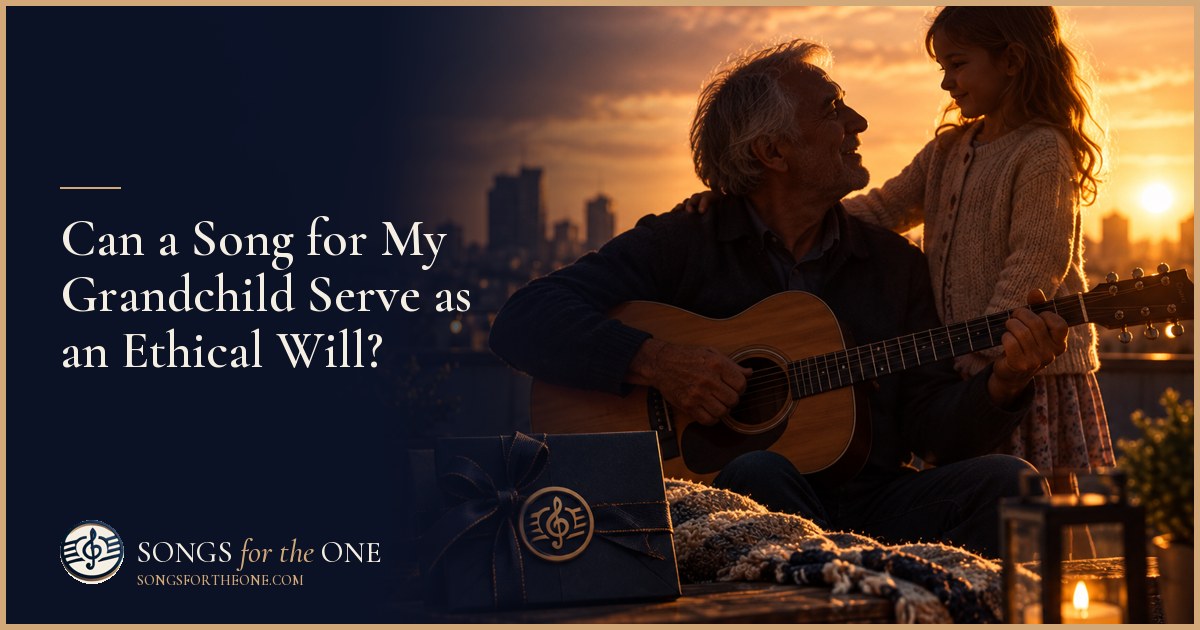
Can a Song for My Grandchild Serve as an Ethical Will?
· 5 min read · By the Songs for the One team
The short answer
An ethical will song can share your values, memories, and hopes with your grandchild. It serves as a personal legacy, not a substitute for legal estate documents. A meaningful song explains what mattered in your life while leaving your grandchild free to choose their own path.
Key takeaways
- Use the song to share values and memories, not property instructions.
- Choose one lived example instead of a long list of lessons.
- Express hopes without making love depend on your grandchild’s choices.
- Keep estate directions in appropriate legal documents.
- Save the song and lyrics alongside a written legacy letter.
What is an ethical will, and can it be a song?
An ethical will is a personal statement of the values, experiences, and hopes you want to pass on. Unlike a legal will, its purpose is not to distribute property. It answers a different question: What do I want my family to understand about how I tried to live? You may also hear it called a legacy letter, though it does not have to take the form of a letter.
A song can serve that purpose when it carries a clear, personal message. A remembered scene, a lesson you learned imperfectly, and a few words of encouragement can give your grandchild something meaningful to return to. The song need not summarize your whole life. It can preserve one important part of your relationship in a form they can hear.
For example, you might build a song around the afternoons you spent repairing bicycles together. The deeper message could be patience, resourcefulness, or showing up for someone who needs help. The bicycle makes the value concrete. Rather than simply advising your grandchild to be generous, you are reminding them what generosity looked like in time you shared.
Why doesn't a legacy song replace a legal will?
A legacy song should not be relied on to distribute assets, appoint someone to manage your estate, or establish healthcare wishes. Those matters belong in appropriate legal documents that meet the requirements where you live. Calling a song an ethical will describes its personal purpose, not its legal status. This article offers general information, not advice about your particular estate.
Keep promises about money, possessions, and inheritance out of the lyrics. For example, a line saying that a particular grandchild will receive your house could create expectations or confusion, especially if your estate documents say something different. A song can explain why your home mattered to you without saying who should own it. Ask a qualified local estate-planning professional about property decisions.
If you mention the song in a legacy letter, explain that it shares personal memories and values rather than estate instructions. That explanation helps your family understand your intention, but it does not replace proper legal planning. If you have already written lyrics containing a promise about property, have a professional review the issue rather than assuming the musical format makes it harmless.
Which values and memories should I include?
Start with three questions: When did I feel most connected to this grandchild? What did that moment reveal about something I value? What do I most want them to hear from me now? Write short answers in ordinary language. Details such as a rainy walk, a flour-covered counter, or a familiar greeting will usually give you more useful material than broad phrases about living a good life.
Choose one central value and perhaps one supporting idea. For example, a song about kindness might recall how you and your grandchild brought dinner to a neighbor. You could connect that memory to your belief that small acts count. You do not need to add every other lesson about work, money, faith, and family. A focused message gives the song room to breathe.
Include some humility. Your grandchild may learn more from hearing that you had to practice apologizing than from hearing a list of rules you always followed. If faith matters to you, describe what it has meant in your life without assuming your grandchild must experience it identically. A companion letter can hold longer family history or explanations that would crowd the song.
How can I offer guidance without creating pressure?
Speak from your own experience rather than prescribing your grandchild’s future. There is a meaningful difference between sharing how education expanded your choices and telling them which career they must pursue. Your song can offer a compass without setting a compulsory route. Look for wording that communicates trust in their judgment as well as the values you hope will help them.
For example, instead of asking a grandchild to keep a family business going, you could celebrate the care you put into your work and wish them work they find meaningful. Instead of asking them never to leave home, you could tell them they remain loved wherever they live. These are ways to preserve the feeling behind a hope without turning it into an obligation.
Read the message as if your grandchild were hearing it during a difficult year. Would it still feel welcoming if they changed beliefs, struggled at school, or made a choice you did not expect? Remove comparisons with siblings or cousins, requests to resolve family disputes, and secrets that are not yours to share. An ethical will can be honest without making its recipient responsible for your peace of mind.
How do I turn my message into a personalized song?
You can begin with a handwritten letter, a recorded conversation, or a short outline. Those are worthwhile legacy forms in their own right, especially if preserving your actual voice is important. To make a song, gather one memory, one main feeling, a musical style, and the sentence you most want your grandchild to remember. No polished verse is necessary.
With Songs for the One, you choose an occasion and talk or type with Muse for about 3 to 7 minutes. Muse gathers five Song DNA elements: The One, The Moment, The Feeling, The Sound, and The Message. You can see story notes of what Muse understood. The how it works page explains the process, which requires no songwriting or music skills.
Songs are original and AI-assisted, with AI vocals rather than your own voice; there is no voice cloning. You hear a free preview before deciding whether to buy the full song. The Song package costs $79 and includes the full song, an MP3 download, a gift page, a lyrics sheet, and five re-records. You can check package options before choosing what you need.
How should I share and preserve the song?
Consider sharing it while you can talk about it together. You might introduce it simply as a memory and a few things you wanted your grandchild to know. Let them respond in their own way, including quietly. For a younger child, a parent or caregiver can help save it until its fuller meaning becomes clear. There is no need to frame it as a farewell.
Save the downloaded MP3 and lyrics in more than one place, and let a trusted person know where they are. A dated companion letter can identify the people and memories mentioned and distinguish the personal message from estate instructions. Songs for the One gift pages are accessible to anyone with the link, so avoid including sensitive family information and share the link thoughtfully.
Before you finish, ask whether the message sounds like you and whether it leaves your grandchild feeling loved rather than directed. One honest memory is enough to begin. When you are ready, start a song for your grandchild and hear a free preview before deciding whether to purchase the full song.
Frequently asked questions
- Does an ethical will song need to mention death?
- No. It can celebrate a living relationship and share values for the years ahead. You can give it for a birthday, a milestone, or simply because you want your grandchild to hear the message now.
- Can I make one legacy song for all my grandchildren?
- You can share a family legacy message with several grandchildren, but a song addressed to one grandchild allows more personal detail. Songs for the One makes personalized songs for one person, so choose the recipient and the memory that belongs to your relationship.
- Should I keep a written ethical will as well?
- A written companion can preserve longer stories, explain references, and record the date and context of your message. It complements the song, but it also should not be used as a substitute for appropriate legal estate documents.
- Will my grandchild hear my own singing voice?
- Not in a Songs for the One song, which uses AI vocals and does not offer voice cloning. If your own voice matters to the legacy, make a separate spoken recording to share alongside the song.
- Can my song include religious beliefs?
- Yes. Faith content is optional. You can describe the beliefs and practices that sustained you while making clear that your love for your grandchild does not depend on their sharing those beliefs.
Plan your song
Further reading
- Great questions to ask the people you loveStoryCorps
- Friends and family advice for grandparentsAARP
- The science of gratitudeGreater Good Science Center, UC Berkeley